
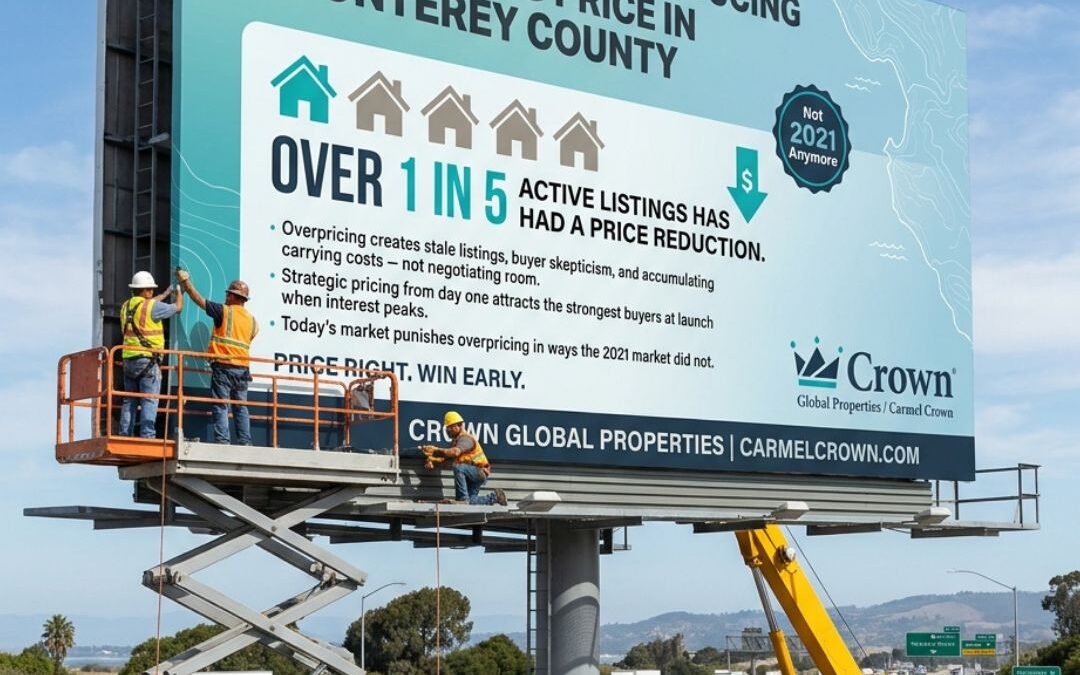
More Sellers Are Reducing Their Asking Price — What It Means for the Monterey County Market
When more than one in five active listings in a market has undergone a price reduction, it signals something worth paying attention to — not a market in crisis, but a market in recalibration. That is precisely where Monterey County stands today.
Price reductions are a normal feature of any functioning real estate market. They become meaningful data when their frequency rises above historical norms, as it has here. Understanding what is driving this trend, and what it means for sellers and buyers navigating the Monterey Peninsula right now, is the practical work of informed real estate decisions.
Why Price Reductions Are Rising
The primary driver is straightforward: some sellers entered the market with asking prices that outpaced what qualified buyers were willing — or able — to pay. This is not unusual following a period of strong appreciation. When values rise quickly, sellers and their advisors sometimes anchor to peak comparables rather than current market conditions. The result is a listing that sits, accumulates days on market, and eventually requires a correction.
Several factors have converged in Monterey County to make accurate pricing more critical than it was in 2021 or 2022. Inventory has increased significantly — buyers have more options than they did three or four years ago, which means an overpriced listing no longer benefits from the urgency of a shortage. Interest rates remain elevated relative to the low-rate environment that defined the pandemic-era market. And buyers, who have been adjusting to these conditions for some time, have become more disciplined in their offers.
The combination of more supply and more selective buyers creates a market that punishes overpricing in a way that the tight-inventory market of the early 2020s largely did not.
What Overpricing Actually Costs a Seller
There is a common theory that pricing high gives a seller room to negotiate. The data does not support it as a general strategy, particularly in the current environment.
When a listing is overpriced, the most likely sequence of events is this: the property generates initial interest from buyers who view it as a comparable, then passes through their consideration without an offer as they see the gap between asking price and value. Days on market accumulate. The listing goes stale. At that point, a price reduction — even a meaningful one — may not recover the initial momentum, because the market has already evaluated and moved on.
Homes that have sat on the market for 60 or 90 days before a price reduction carry a different negotiating position than homes that were correctly priced from day one. Buyers ask: why has this not sold? They often answer that question, rightly or wrongly, with skepticism about the property itself — even when the real explanation is simply that the original price was too high.
Beyond the psychological dynamics, there is the practical reality of carrying costs. Every month a property sits unsold is another mortgage payment, another round of property taxes, another period of maintenance and insurance. The cost of an overpricing strategy is rarely visible on a listing sheet, but it is very real.
Strategic Pricing and What It Actually Means
Strategic pricing is not the same as underpricing. The goal is not to leave money on the table — it is to position a property where it will attract the broadest qualified pool of buyers at the moment of launch, when buyer interest is at its peak.
Properties that are correctly priced from the outset tend to generate multiple showings in the first week, often produce competing offers, and close at or near asking price within a reasonable timeframe. That outcome — a clean transaction, market-rate proceeds, and a predictable timeline — is what most sellers actually want when they think carefully about their priorities.
The mechanics of pricing strategy on the Monterey Peninsula require genuine local knowledge. This is a micro-market within a micro-market. A property in Carmel-by-the-Sea does not price the same way as a comparable property in Carmel Valley or Pacific Grove, even if the square footage and bedroom count are identical. Ocean proximity, lot character, architectural style, and the specific neighborhood’s buyer pool all factor into where a property should be positioned. Comparables from three counties over are not useful here.
What Buyers Should Take From This
For buyers currently active in Monterey County, the rise in price reductions represents a more navigable market than what existed two or three years ago. Properties that have been reduced offer an opportunity to acquire at a price that reflects a correction from initial optimism — and sellers in that position are often more motivated to close cleanly.
At the same time, buyers should not assume that every reduced listing represents a bargain. Some reductions still leave a property priced above market. The reduction itself is not the signal — the relationship between the current asking price and actual comparable sales data is what matters.
The Practical Takeaway
Whether you are approaching the market as a seller or a buyer, the current pattern of price reductions in Monterey County points to the same underlying principle: accurate pricing, grounded in current data and genuine local expertise, produces better outcomes than optimistic assumptions on either side of the transaction.
For sellers, the question is not whether the market will eventually meet your price. In most cases, it will not. The question is how much time and carrying cost you are willing to spend finding that out — and whether a strategic approach from the beginning might serve your goals more directly.
For buyers, the expanded inventory and increased price reductions are a signal that patience and discipline are being rewarded in ways they were not during the compressed market of recent years.
If you are weighing a sale on the Monterey Peninsula and want to understand where your property stands in the current market, we are glad to provide a frank, data-driven assessment.
Would you rather price aggressively and negotiate, or price accurately from day one? Share your perspective in the comments.