
How Probate Real Estate Works in California: A Guide for Executors
For 250 years, the right to own property has been one of the foundational principles of American life. The ability to acquire land, build a home, and pass that asset to the next generation sits at the heart of how wealth has been built and transferred across generations in this country. When a property owner passes away, the probate process is California’s legal mechanism for honoring that right — and for ensuring that the transfer happens with transparency, fairness, and proper oversight.
If you have recently become responsible for an estate that includes real property in California, you are likely navigating a process that is unfamiliar, technically complex, and emotionally demanding all at once. This guide is intended to give you a clear, honest picture of how California probate real estate works — what the process requires, how long it takes, and what decisions you will need to make along the way.
Before going further, it helps to identify your actual role, because it shapes nearly everything that follows. Are you the sole beneficiary of the estate? One of several beneficiaries? A trustee named in a living trust? Or someone who has petitioned — or expects to petition — the court to be appointed executor or administrator? Each of these positions carries different authority and different obligations. If you are unsure which applies to you, that is the first question to resolve, ideally alongside a probate attorney, before any decisions about the property are made.
What Probate Is, and When It Applies
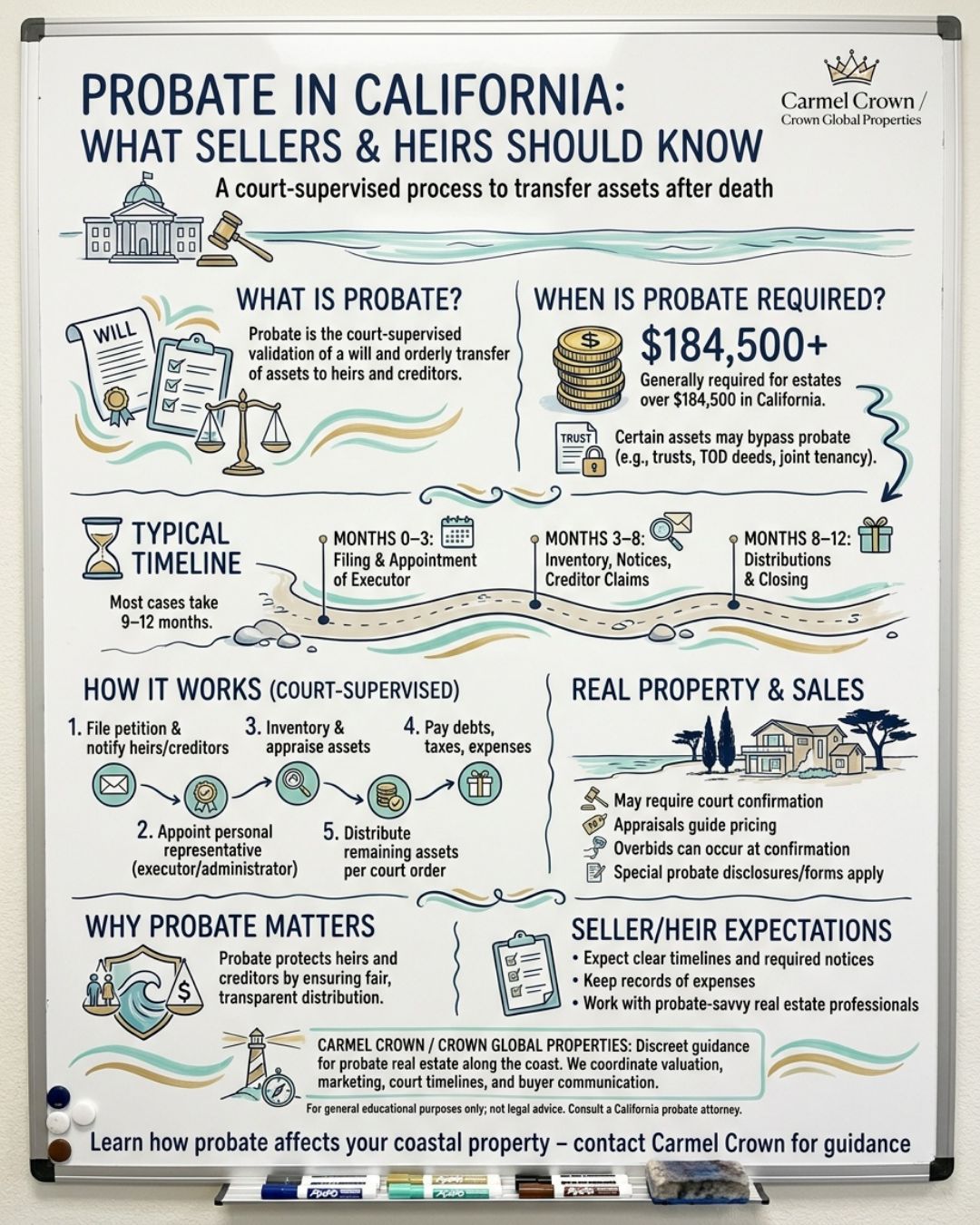
Probate is the court-supervised legal process through which a deceased person’s estate is administered, debts are settled, and assets are distributed to heirs. In California, probate is generally required when a person dies owning assets — including real property — solely in their own name, with a total estate value exceeding $184,500 (the current threshold, subject to periodic adjustment).
Real property held in a living trust, owned jointly with right of survivorship, or with a named beneficiary designation typically passes outside of probate. But a significant portion of California real estate — particularly among older homeowners who never established a trust or whose estate planning documents are outdated — does pass through probate. Across the state, including established communities like the Monterey Peninsula where long-held family homes and investment properties are common, this is not unusual.
The Executor’s Role in a Real Estate Sale
As executor (or administrator, if appointed by the court without a will), your authority over the estate’s real property is granted by the court through Letters Testamentary or Letters of Administration. This document gives you the legal standing to manage the property, list it for sale, accept offers, and close a transaction — subject to the specific requirements of the probate process.
Your responsibilities as executor include:
- Securing and maintaining the property during the probate period
- Obtaining a professional appraisal (required by the court — typically performed by a probate referee appointed by the California State Controller’s Office)
- Selecting a real estate broker with probate experience to list and market the property
- Reviewing and accepting offers in accordance with probate law requirements
- Navigating the court confirmation process if required
- Distributing net proceeds to the estate according to the court’s direction
Each of these steps carries legal weight. Mistakes — including accepting an offer below the court-required minimum, failing to properly notice creditors, or distributing assets prematurely — can expose the executor to personal liability.
The Probate Timeline in California
California probate is not a fast process. A straightforward, uncontested probate case — one without disputes among heirs, creditor claims, or title complications — typically takes a minimum of nine to twelve months from the date the petition is filed with the court. More complex cases can extend to two years or longer.
For the real property component specifically, the timeline is influenced by several factors: how quickly the property is appraised, how long it takes to list and accept an offer, and — most significantly — whether the sale requires court confirmation. Court confirmation adds a mandatory waiting period and a court hearing to the process, which can extend the sale timeline by 60 to 90 days beyond what a standard transaction would require.
Independent Administration vs. Court Confirmation
California’s Independent Administration of Estates Act (IAEA) allows many executors to sell real property without court confirmation — a significant simplification of the process. Under IAEA, the executor has authority to accept an offer and close a sale without returning to the court for approval, as long as proper notice is given to heirs and interested parties and no one objects within the notice period.
However, IAEA authority is not universal. It must be granted by the court at the beginning of the probate case, and the will or the heirs may limit or object to it. If the estate does not have IAEA authority — or if the executor has only limited authority — the sale will require court confirmation, which involves a more structured process including a minimum offer price, public notice, and an overbidding procedure at the court hearing.
Understanding which of these paths applies to your estate is one of the first and most important clarifications to make with your probate attorney.
A Note on Choosing Your Probate Attorney
Retaining an experienced probate attorney is essential — but it is worth knowing that not every attorney who markets themselves as a “probate specialist” has deep, current experience with estates that involve real property. The mechanics of a probate sale, the notice requirements, and the court confirmation process reward counsel who work in this area regularly. If you would find it helpful, Crown Global Properties has worked alongside experienced probate and trust attorneys and is glad to share those relationships — whether you are still selecting counsel or want a second set of eyes alongside the attorney you already have.
Pricing and Preparing the Property for Sale
The court-appointed probate referee will appraise the property at fair market value for estate tax and accounting purposes. This appraisal establishes a floor — California law requires that any accepted offer be at least 90% of the probate referee’s appraised value in a court confirmation sale.
Separately, your real estate broker will prepare a market analysis to help position the property competitively. These two figures — the probate appraisal and the current market value — are not always identical, and understanding the relationship between them is important for setting a realistic asking price and managing heir expectations.
Properties sold through probate are typically sold in “as-is” condition, meaning the estate does not make repairs or provide warranties. Buyers are expected to conduct their own inspections and due diligence. This affects both pricing strategy and the pool of buyers likely to be interested — probate buyers are often investors or experienced buyers who understand the process and are comfortable with the conditions.
Working with a Probate Real Estate Specialist
Not all real estate brokers are equipped to handle probate sales. The process involves specific legal requirements, court timelines, documentation obligations, and coordination with probate attorneys that fall outside the scope of a standard residential transaction. A broker without probate experience can inadvertently create legal complications, mismanage the court confirmation process, or fail to properly document the sale in ways that satisfy the court’s requirements.
Selecting a real estate broker who works regularly in probate — and who has established relationships with probate attorneys, title officers, and the court system — is one of the most consequential decisions an executor makes.
If you are managing an estate with real property anywhere in California and want to understand what the process looks like specifically for your situation, we welcome a direct conversation. No obligation — just a frank exchange of information to help you make informed decisions during a difficult time.
What aspect of the probate process has been most confusing or unexpected for you? We would be glad to hear your questions in the comments.